Blog
8µm (60AWG) versus 10µm (58AWG) coils for Catheter navigation or mapping
By R&D Swiss Coils, published 2.7.2026
Reading time; 3 minutes
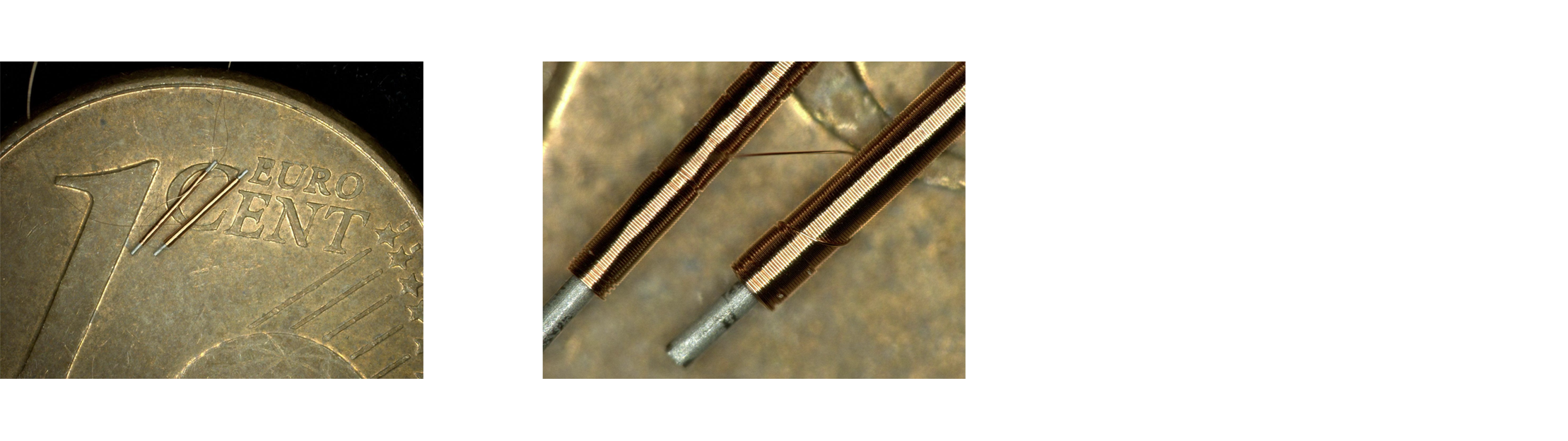
Every now and then at Swiss Coils we get the question if we are capable of winding 8µm coils, coils wound with a copper wire of 8 micrometer diameter bare copper. The answer is Yes. Next question is; what is the difference between 8µm and 10µm coils? This is what we will try to answer in this article.
The coils can be Air Coils, round or oval shaped made of copper wire with no support. Or the coils can be wound on a support, mostly soft iron (mu-metal, HiMu80 or similar). In this article we concentrate on the last type of coils.
Making Orthocyclic or perfectly wound coils with 10µm wire on a tiny soft iron 'wire shaped core' in an industrial way is possible and something Swiss Coils does. This way of winding creates the lowest Overall Diameter possible for the coil. The longer the soft iron core, the harder it is to wind orthocyclic due to the 'swinging' of the core in the coiling machine. A core of ca 0.1mm in diameter with a length of 5.6mm can be wound properly with 10µm, 8µm is more critical and the shape of the coil is often not as perfect as the 10µm. Winding on shorter cores will improve the quality of the visual aspect. With an increasing number of layers it becomes harder and harder to create perfectly wound coils. At Swiss Coils we wind 10µm coils up to 10 layers without problems, depending the length of the core and coil.
What does this mean for the performance of the coils?
We made a simple imaginary specification, coil length: 2.7mm, Number of turns: 1085 and compared the two coils with the different wire sizes.
Coil 1 wire diameter bare wire: 10µm, overall diameter with isolation and bond coat: 12.2µm.
Coil 2 wire diameter bare wire: 8µm, overall diameter with isolation and bond coat: 9.6µm.
Inductance Coil 1 at 10kHz: 1.7mH, Rdc = 148Ω, Sensitivity at 10kHz: 0.43, Overall diameter: 0.27mm*
Inductance Coil 2 at 10kHz: 1.64 mH, Rdc = 215Ω, Sensitivity at 10kHz: 0.39, Overall diameter: 0.2mm
* Note that coil 1 has 6 layers to fit the number of turns, coil 2 only 4 layers. If coil 1 should be reduced to 4 layers the number of turns must be lowered to 855 turns. This will reduce the inductance to 1mH, sensitivity to 0.32, Rdc to 110Ω and the OD to 0.22mm.
Conclusion
For this kind of coil, 8µm can give a benefit if a smaller coil OD is needed. The biggest downside; handling 10µm or smaller wire to make sensors is a job for specialists. The small wires can still be soldered with tin, as Swiss Coils we wind the coil on the soft iron bobbin and attach to it a connector for testing. The wires are soldered to the connectors, also 8um. After testing the connectors are removed or remain if this is benefitial for the costumer. Price wise there is also an impact, the 8µm wire is roughly 30x more expensive than 10µm. Not much wire is on the coil in weight, but it must be take in consideration.
Contact product.enquiries@swisscoils.com for more information if this article was interesting and more information is needed or you would like to try your configuration.

Winding coils for Catheter navigation or mapping directly on the core
By R&D Swiss Coils, published 9.5.2026
Reading time; 2 minutes
Winding 10µm (58AWG) or 8µm (60AWG) copper wire directly on soft iron (mu-metal or HiMu80, etc.) core shapes, benefits and considerations.
Often for very tiny coils, mostly used in catheter mapping or navigation, the coils are made as Air Coils and in a second operation a tiny annealed core is inserted in the coil. This has the benefit that the air coil can be wound in a fully automated way in mass production. So the coil can be produced in an economical way but to get at the required electrical specification often a soft iron core or bobbin must be added. The assembly of the coil and the core is a time consuming operation. An operator has to pick the core and coil and glue the core in the coil. The position of the core, the angle of the core vs. the coil, the air gap between core and coil influences the performance of the overall assembly. Then is there the risk of damaging the coil, breaking wires, scratching the inside of the coil or outside of the coil during the manipulations.
Another possibility is to wind directly on the core. Many of the disadvantages mentioned above are gone, but a big advantage is the absence of the air gap between the coil and the core and the overall diameter of the coil can be smaller. This boosts the performance of the coil in a magnetic field. Then also much longer coils are possible.
At Swiss Coils we cut the core at the specified length and anneal the cores to get the best magnetic performance. Then we place the core in the winding machine and wind directly on the core. A connector is also attached in the machine which gives the possibility to test the coil. This is needed as the core is not isolated. A disadvantage of directly winding on the core is the risk of having short circuits between the cores and the copper windings of the coil. For this reason the coils are tested 100% on short circuits between the coil and the core. To do this Swiss Coils connects the wires of the coil to a small connector, solders the wires to the connector (also 8µm) and does the tests. After testing the connectors are removed or, if the client prefers, shipped with the connector included. This testing significantly reduces the risk of supplying coils with short circuits.
Conclusion
Winding directly on an annealed soft iron bobbin has benefits if a smaller coil is needed with better electrical performance. Disadvantage is the short circuit risk wire to core which at Swiss Coils is measured 100% to reduce the risk.
Contact product.enquiries@swisscoils.com for more information if this article was interesting and more information is needed or you would like to try your configuration.